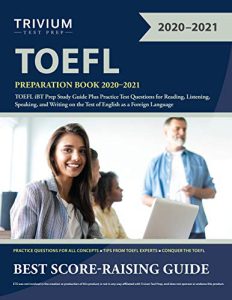
tofel
Test of English as a Foreign Language (TOEFL /ˈtoʊfəl/ TOH–fəl) is a standardized test to measure the English language ability of non-native speakers wishing to enroll in English-speaking universities. The test is accepted by more than 11,000 universities and other institutions in over 190 countries and territories. TOEFL is one of several major English-language tests in the world, others including IELTS, Cambridge Assessment English and Trinity College London exams.
TOEFL is a trademark of the Educational Testing Service (ETS), a private non-profit organization, which designs and administers the tests. ETS issues official score reports which are sent independently to institutions and are valid for two years following the test.
قیمت : 500,000 تومان
- تعداد جلسات : 14 جلسه
- زمان هر جلسه : 80 دقیقه
دسته ها: دوره بزرگسالان (بالای 17 سال)
توضیحات بیشتر در مورد دوره :
The TOEFL Internet-based test (iBT) measures all four academic English skills- reading, listening, speaking, and writing. Since its introduction in late 2005, the Internet-based Test format has progressively replaced the computer-based tests (CBT) and paper-based tests (PBT), although paper-based testing is still used in select areas. The TOEFL iBT test has been introduced in phases, with the United States, Canada, France, Germany, and Italy in 2005 and the rest of the world in 2006, with test centers added regularly. It is offered weekly at authorized test centers. The CBT was discontinued in September 2006 and these scores are no longer valid.[citation needed]
Initially, the demand for test seats was higher than availability, and candidates had to wait for months. It is now possible to take the test within one to four weeks in most countries.[8] Now, people who wish to take the test create an account on the official website to find the closest place. In the past this test lasted 4 hours, today people can choose to take the test around 3 hours. The test consists of four sections, each measuring one of the basic language skills (while some tasks require integrating multiple skills), and all tasks focus on language used in an academic, higher-education environment. Note-taking is allowed during the TOEFL iBT test. The test cannot be taken more than once every 3 days, starting from September 2019.[9]
One of the sections of the test will include extra, uncounted material. Educational Testing Service includes extra material to pilot test questions for future test forms. When test-takers are given a longer section, they should give equal effort to all of the questions because they do not know which question will count and which will be considered extra. For example, if there are four reading passages instead of three, then one of the passages will not be counted. Any of the four could be the uncounted one.
| showCountries and territories offering the TOEFL iBT test |
|---|
- Reading
- The Reading section consists of questions on 3-4 passages, each approximately 700 words in length and with 10 questions. The passages are on academic topics; they are the kind of material that might be found in an undergraduate university textbook. Passages require understanding of rhetorical functions such as cause-effect, compare-contrast and argumentation. Students answer questions about main ideas, details, inferences, essential information, sentence insertion, vocabulary, rhetorical purpose and overall ideas. New types of questions in the TOEFL iBT test require filling out tables or completing summaries. Prior knowledge of the subject under discussion is not necessary to come to the correct answer.
- Listening
- The Listening section consists of questions on 2-3 conversations with 5 questions each, and 3-4 lectures with 6 questions each. Each conversation is 2.5–3 minutes and lectures are 4.5-5.5 minutes in length. The conversations involve a student and either a professor or a campus service provider. The lectures are a self-contained portion of an academic lecture, which may involve student participation and does not assume specialized background knowledge in the subject area. Each conversation and lecture passage is heard only once. Test-takers may take notes while they listen and they may refer to their notes when they answer the questions. The listening questions are meant to measure the ability to understand main ideas, important details, implications, relationships between ideas, organization of information, speaker purpose and speaker attitude.
- Speaking
- The Speaking section consists of 4 tasks: 1 independent (Task 1) and 3 integrated (Task 2, 3, 4). In task 1, test-takers answer opinion questions on familiar topics. They are evaluated on their ability to speak spontaneously and convey their ideas clearly and coherently. In task 2 and 4, test-takers read a short passage, listen to an academic course lecture or a conversation about campus life and answer a question by combining appropriate information from the text and the talk. In task 3, test-takers listen to an academic course lecture and then respond to a question about what they heard. In the integrated tasks, test-takers are evaluated on their ability to appropriately synthesize and effectively convey information from the reading and listening material. Test-takers may take notes as they read and listen and may use their notes to help prepare their responses. Test-takers are given a short preparation time before they have to begin speaking. The responses are digitally recorded, sent to ETS’s Online Scoring Network (OSN), and evaluated by three to six raters.
- Writing
- The Writing section measures a test taker’s ability to write in an academic setting and consists of two tasks: one integrated and one independent. In the integrated task, test-takers read a passage on an academic topic and then listen to a speaker discuss it. The test-taker then writes a summary about the important points in the listening passage and explains how these relate to the key points of the reading passage. In the independent task, the test-taker must write an essay that states their opinion or choice, and then explain it, rather than simply listing personal preferences or choices. Responses are sent to the ETS OSN and evaluated by at least 3 different raters.[10]
| Task | Description | Approximate time |
|---|---|---|
| Reading | 3-4 passages, each containing 10 questions | 54–72 minutes |
| Listening | 5-7 passages, each containing 5–6 questions | 41–57 minutes |
| Break | Mandatory break | 10 minutes |
| Speaking | 4 tasks | 17 minutes |
| Writing | 2 tasks | 50 minutes |
Home edition
The TOEFL iBT Home Edition is essentially the same test as the TOEFL iBT. However, it is taken at home while a human proctor watches through a web-camera (usually built-in to most laptops) and via sharing of the computer screen. The popularity of the Home Edition has grown during the COVID-19 pandemic as it has been the only option during lock-downs. Many students experience technical or security problems during the Home Edition tests. The ETS browser used to administer the test has been unreliable in many cases. Students who have their exams interrupted are not likely to get a refund or the chance to reschedule for a new test as the ETS as technical problems are hard to document and the processing of a complaint is slow due to the popularity of the Home Edition and the number of complaints. If the test runs smoothly, the results are accepted by most companies and universities that accept the TOEFL iBT standard edition.Paper-delivered Test
The TOEFL Paper-delivered Test is an official test for use where the internet test is unavailable, usually due to internet & computer issues. It consists of the Listening, Reading, and Writing sections, with scores that are the same scale as the Internet Based Test. There is no total score. Not all centers have the possibility of delivering this type of test, so it will generally be necessary to reschedule the day of the test on another available day.Paper-based test
The TOEFL paper-based Test (PBT) was still available in limited areas until 2017, when it was replaced by the Paper-delivered test. Scores are valid for two years after the test date, and test takers can have their scores sent to institutions or face time.- Listening (30 – 40 minutes)
- The Listening section consists of 3 parts. The first one contains 30 questions about short conversations. The second part has 8 questions about longer conversations. The last part asks 12 questions about lectures or talks. Harder questions are worth two scores.
- Structure and Written Expression (25 minutes)
- The Structure and Written Expression section has 15 exercises of completing sentences correctly and 25 exercises of identifying errors. Harder questions are worth two scores.
- Reading Comprehension (55 minutes)
- The Reading Comprehension sections has 50 questions about reading passages. Harder questions are worth two scores.
- Writing (30 minutes)
- The TOEFL PBT administrations include a writing test called the Test of Written English (TWE). This is one essay question with 250–300 words on average.
Accommodations
There are three different categories of accommodations that can be utilized for TOEFL test takers. Some of these accommodations are available for all students and some are only available for those with certain disabilities. If the accommodation the student requires isn’t available then requests can be made through the Testing Accommodations Request Form. For questions, ETS provides Disability Services that can be contacted.- Technical Accommodations
- Screen Magnification
- Selectable background and foreground
- Kensington® Trackball mouse
- IntelliKeys® keyboard
- Ergonomic Keyboard
- Keyboard with touchpad
- Specialized Assistance
- Sign language interpreter for spoken directions only
- Oral interpreter for spoken directions only
- Oral interpreter for Listening section only
- Writer/recorder of answers
- Test reader
- Adaptive Accommodations
- Audio version of the test
- Reader’s script version of the test
- Braille test (in contracted or uncontracted Braille)
- Braille test with reader’s script
- Large-print version of the test
- Regular print version of the test
- Listening section omitted
- Speaking section omitted
- Extended testing time
- Additional rest breaks
- Transcripts of audio elements in Speaking and Writing sections.